· David Cruz · Schools & Special Education · 8 min read
How ABA Data Collection Apps Support School-Based Teams
Learn how digital data collection helps school teams implement ABA with fidelity, bridge the knowledge-application gap, and meet federal evidence-based practice requirements.

Key Takeaways
School-based ABA teams face a critical implementation gap. Even with training, maintaining consistent data collection across multiple students and staff is difficult with paper-based methods. Apps like TallyFlex bridge this gap by standardizing operational definitions, enabling real-time data sharing across staff, and supporting BCBA oversight across multiple classrooms - all on the devices schools already have, including Chromebooks.
Federal law mandates evidence-based practices in special education. Applied Behavior Analysis is one of the most thoroughly researched approaches for supporting students with behavioral challenges. Yet many schools struggle to implement ABA with the fidelity that makes it effective.
The gap between knowing ABA principles and applying them consistently in a busy classroom is real. Special education teachers, paraprofessionals, and related service providers juggle dozens of students, shifting schedules, and competing demands. Paper-based data collection adds friction. Inconsistent measurement undermines the very decisions that should be data-driven.
This is where data collection apps become more than convenience - they become infrastructure for implementation fidelity. TallyFlex was built for exactly this: standardized behavior tracking that works during instruction, not after it.
The Implementation Fidelity Problem

The disconnect in special education settings is well-documented: staff may understand ABA concepts - reinforcement schedules, antecedent interventions, data-based decision making - but maintaining procedural fidelity during instruction is harder than it appears.
Consider a paraprofessional working with three students simultaneously. One student needs frequency data on hand-raising. Another needs interval recording for engagement during seated work. A third has a behavior support plan with two paired trackers - frequency data on aggression toward peers and frequency data on requesting a break (the FCT replacement the team is teaching) - plus ABC data on each aggression incident. Paper methods fail here. The cognitive load is too high. Data quality suffers.
When data quality suffers, decisions suffer. And when decisions suffer, student outcomes suffer.
Why Paper Methods Fall Short
Paper data sheets were designed for controlled settings with predictable schedules and one-to-one ratios. Schools rarely have that luxury. Typical challenges include:
Multiple students, one adult. A paraprofessional or special education teacher often supports 3-8 students simultaneously. Paper systems designed for individual clients don’t scale.
Interrupted data collection. Transitions, fire drills, schedule changes, and unexpected behaviors interrupt sessions constantly. Paper sheets can’t pause and resume gracefully.
Delayed analysis. Paper data sits in folders until someone enters it into a spreadsheet. By then, the behavior pattern may have shifted. The window for adjusting intervention closes.
Inconsistent procedures. Without standardized operational definitions at everyone’s fingertips, two staff members measuring the “same” behavior may record very different things.
How TallyFlex Supports Implementation Fidelity
TallyFlex addresses each of these barriers directly. Here’s how.
Standardized Operational Definitions
When a BCBA sets up a tracker in TallyFlex, they define exactly what counts as the target behavior - including examples and non-examples. That definition is available whenever staff record data. No more relying on memory or hunting for paper protocols.
For example, a BCBA might define “physical aggression” as: “Any forceful contact directed at another person’s body, including hitting, kicking, biting, scratching, or throwing objects at someone. A new instance begins after 3 seconds without aggressive contact. Non-examples: light taps that produce no sound or mark, accidental contact during play, falling against a peer, or contact during movement transitions.” The same template includes the paired replacement behavior the team is teaching (“requesting a break”) so the data on the reduction target sits next to data on the skill being built (BACB Code 2.14).
Every paraprofessional, every teacher, every substitute sees that definition before recording. When everyone measures the same way, you can trust the data.
Real-Time Data Sharing Across Staff
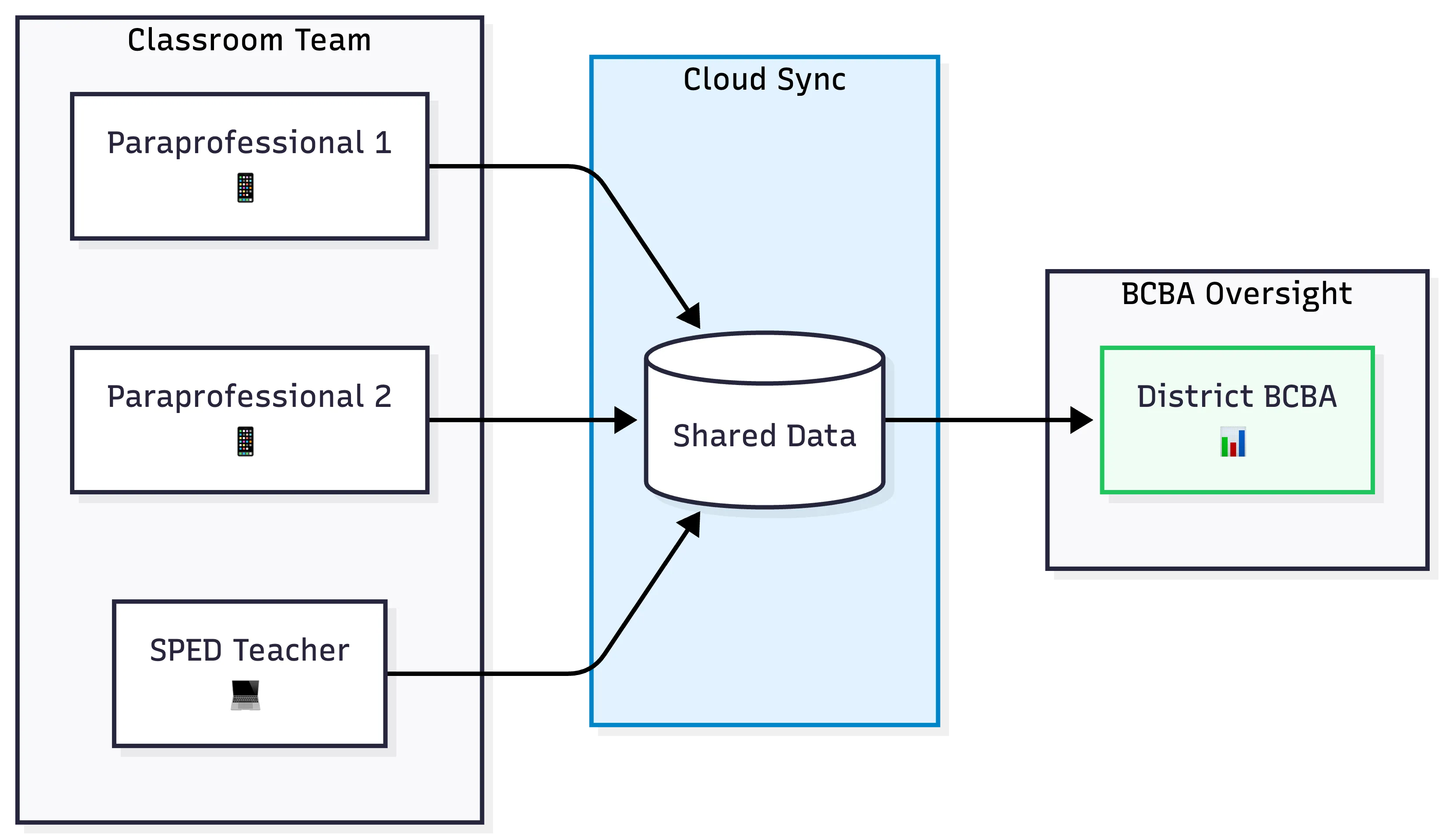
With TallyFlex, multiple staff members can collect data on the same student simultaneously. The BCBA overseeing five schools can review dashboards without driving to each site. When a concerning pattern emerges - escalating frequency, changing antecedents - the BCBA sees it the same day, not weeks later.
This matters especially for schools with limited BCBA coverage. Many districts share one BCBA across multiple buildings. Data collection apps extend their reach by making every data point immediately accessible.
Automatic Timers and Interval Prompts
Interval recording requires precise timing. Partial interval, whole interval, and momentary time sampling each demand attention to the clock while observing behavior. Traditional methods require staff to watch a timer and record simultaneously.
TallyFlex handles the timing automatically. The app prompts staff at each interval. For partial interval, they indicate whether the behavior occurred at any point during the interval. For whole interval, they indicate whether it occurred throughout the entire interval. For momentary time sampling - often the most practical method for busy classrooms - staff only need to observe at the exact moment of the prompt and record whether the behavior is occurring. The cognitive load drops significantly across all methods. Accuracy improves.
Immediate Visual Feedback
When staff can see a trend line update after each session, the impact of their interventions becomes concrete. A paraprofessional watching aggressive incidents decline as break-requests rise over three weeks connects their consistent antecedent strategies and FCT (functional communication training) teaching to the outcome.
This feedback loop reinforces good implementation. Staff see that their efforts matter, and the data becomes motivating rather than burdensome.
Practical Workflows for School Teams
Here’s how a well-implemented data collection system flows in a school setting.
Morning Setup
The SPED teacher reviews the day’s schedule. She sees which students have data collection goals active, which recording methods apply, and any notes from yesterday’s sessions. Three paraprofessionals check in on their devices. Everyone’s on the same page before students arrive.
During Instruction
A paraprofessional works with two students at a table. Student A has two paired frequency trackers active - one for hand-raising and one for requesting a break (the FCT replacement the team is teaching). She taps the screen each time he uses either skill. Student B has an interval recording session running for engagement during seated work - the app prompts her at each interval and she records a quick response.
When Student A engages in aggression, she opens the ABC data form. She selects the antecedent (peer took his pencil), behavior (hit peer on arm), and consequence (redirected to break area) from pre-configured categories. The whole entry takes seconds. She also notes whether Student A used the break-request skill before or after the incident - that data is what shows the team how the FCT teaching is generalizing. She returns to instruction.
End of Day Review
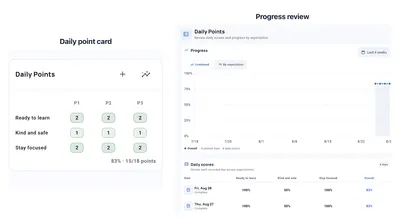
The SPED teacher reviews the day’s data during planning period. She notices Student B’s on-task percentage dropped from 78% to 54% this week. She flags this for the BCBA and adds a note about the classroom aide being absent.
BCBA Consultation
The district BCBA, covering four elementary schools, reviews her dashboard remotely. She sees the flagged student, reviews the data pattern, and schedules a classroom observation for tomorrow. She also notices Student A’s aggression data shows a new antecedent pattern - most incidents now follow peer interactions rather than academic demands - and that break-request frequency rose during academic time but stayed flat during peer time. The replacement skill is generalizing in one context and not the other. She updates the behavior intervention plan to extend FCT teaching to peer interactions before the next IEP meeting.
Meeting Federal Requirements
The Individuals with Disabilities Education Act (IDEA) requires IEP services to be based on “peer-reviewed research, to the extent practicable.” The Every Student Succeeds Act (ESSA) goes further, defining tiered evidence standards for educational interventions. Together, these laws create an expectation that schools can demonstrate their interventions are implemented as designed and that data supports their effectiveness.
Digital data collection creates automatic documentation trails. Timestamps show when data was collected. Audit logs demonstrate consistent implementation. Progress monitoring data feeds directly into IEP goal tracking.
For FERPA compliance, look for apps that store data securely with proper encryption and access controls. Student data should never leave the school’s control without appropriate safeguards. See our FERPA guide for school-based ABA for a detailed breakdown of what districts need to know.
What to Look for in a School Data Collection App
Not all data collection apps suit school environments. Clinical apps designed for one-to-one ABA therapy often fail in multi-student classrooms. When evaluating options, consider:
Multi-student workflows. Can staff easily switch between students without losing data? Can they run multiple sessions simultaneously? TallyFlex supports up to 10 concurrent sessions.
Cross-platform access. Schools use Chromebooks heavily. Does the app work on web, iOS, Android, and Chromebook?
Role-based access. Can BCBAs see all students while paraprofessionals only see their assigned caseload?
Offline capability. School Wi-Fi is notoriously unreliable. Does the app work offline and sync when connectivity returns?
Team collaboration. Can multiple staff collect data on the same student with proper syncing?
FERPA compliance. Does the vendor sign data use agreements and understand education data privacy requirements?
The Path Forward
Schools face real constraints - limited BCBA time, high paraprofessional turnover, competing demands on special education staff. Data collection apps don’t replace clinical expertise, but they remove barriers between knowledge and application. They standardize procedures so everyone collects the same way, provide immediate feedback so staff see results, enable remote oversight so BCBAs can support more classrooms, and create documentation so schools can demonstrate compliance.
Ready to Explore?
If your school team is evaluating data collection options, TallyFlex works on the devices you already have - including Chromebooks, even offline. For district-wide implementation, our schools page explains education pricing and FERPA compliance. Questions? Reach out to support@tallyflex.com.