· David Cruz · Schools & Special Education · 10 min read
Data Collection for Paraprofessionals - A Practical Guide
Practical strategies for paraprofessionals collecting behavior data in busy classrooms. Tips for managing multiple students and working with BCBAs.
Key Takeaways
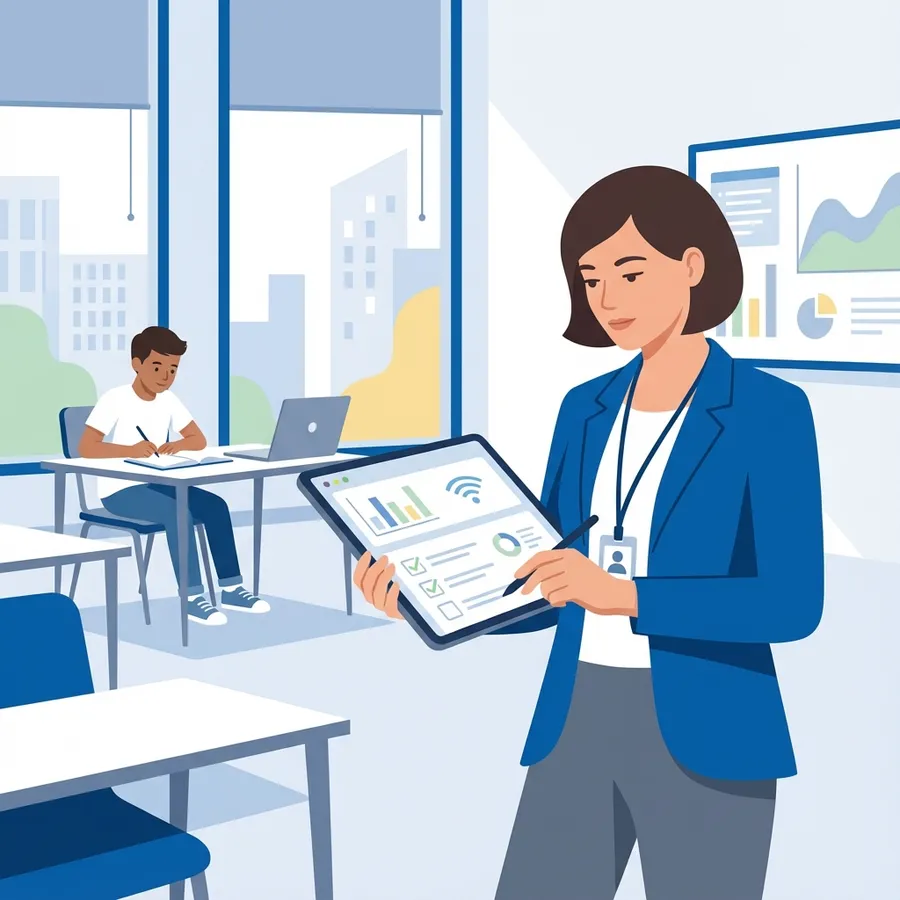
Paraprofessional data collection doesn’t have to be overwhelming. Start with one behavior at a time, use recording methods that match the behavior type, and capture data during the session - not after. The biggest obstacles - managing multiple students, constant interruptions, and unclear expectations - can be addressed through simple strategies and clear communication with your supervising BCBA or special education teacher. Your data matters more than you might realize. It directly shapes the interventions that help students succeed.
Jump to: Practical Tips | Working with Your BCBA | Tools
You’re in the middle of a reading group when a student across the room starts escalating. Another student needs redirection. The fire alarm goes off for a drill. And somewhere in all of this, you’re supposed to be tracking hand-raising frequency for a student’s IEP goal.
If this sounds familiar, you’re not alone. Paraprofessionals are the backbone of special education classrooms, yet data collection training often gets squeezed into a 20-minute overview during orientation. The gap between what you’re expected to do and the support you receive to do it can feel enormous.
This guide is designed to help bridge that gap. We’ll cover practical strategies that work in real classrooms - not idealized scenarios with one student and no interruptions.
Why Your Data Matters More Than You Think
Every tally mark you make, every interval you record, every ABC entry you complete feeds into decisions that shape a student’s education. BCBAs (Board Certified Behavior Analysts) and special education teachers rely on your data to:
- Determine if an intervention is working
- Adjust behavior plans when something isn’t effective
- Write IEP goals based on actual performance
- Justify services and support to administrators and parents
When data is inconsistent or incomplete, those decisions get harder. A student might stay on an ineffective intervention longer than necessary. Progress might be underestimated. Supports might be reduced prematurely.
Your role in data collection isn’t administrative busywork. It’s clinical intelligence that directly affects student outcomes.
Common Challenges Paraprofessionals Face
Before looking at fixes, let’s acknowledge what makes paraprofessional data collection difficult. These aren’t excuses - they’re realities that any practical approach must address.
Managing Multiple Students Simultaneously
Unlike clinical ABA therapy with one-to-one ratios, school paraprofessionals often support 3-8 students at once. You might have three different data sheets for three different students, each requiring a different recording method. Traditional paper systems weren’t designed for this.
The cognitive load of tracking multiple behaviors across multiple students while also providing instruction, redirection, and support is genuinely demanding. If you’ve felt overwhelmed, that’s a reasonable response to an unreasonable situation - not a failure on your part.
Constant Interruptions and Transitions
Fire drills. Assemblies. Schedule changes. A student who needs immediate attention during another student’s data collection period. Schools are dynamic environments where plans rarely survive contact with reality.
Paper data sheets can’t pause. If you miss recording during a critical window, that data point is gone. The pressure to capture everything perfectly while chaos unfolds around you creates stress that makes accurate data collection even harder.
Digital tools like TallyFlex were built for exactly this situation - collect data on multiple students from any device (including Chromebooks), even offline, and your BCBA or teacher sees it the same day.
Limited Training on Recording Methods
Many paraprofessionals receive minimal training on why different recording methods exist and when to use each one. You might be handed a frequency data sheet without understanding that frequency recording only works for discrete behaviors with clear beginnings and endings.
Without this foundation, data collection feels like following arbitrary rules rather than gathering meaningful information. It’s hard to prioritize something you don’t fully understand.
Paper Systems That Don’t Scale
A single data sheet for a single behavior works fine. But when you’re tracking five behaviors across three students, paper becomes unmanageable. Sheets get lost. Different staff record on different forms. Data sits in folders for weeks before anyone enters it into a spreadsheet.
By the time trends become visible, the behavioral patterns may have already shifted. The window for timely intervention closes before anyone notices it was open.
These are exactly the problems digital data collection solves - and why paper systems persist only until teams experience something better.
Practical Tips for Busy Classrooms
These strategies come from working with school teams who face the same challenges you do. They’re not theoretical - they’re battle-tested in environments where everything competes for your attention.
Start Simple - One Behavior at a Time
If you’re new to data collection or returning after a break, don’t try to track everything immediately. Focus on one target behavior for one student until that feels automatic. Then add another.
This isn’t about doing less. It’s about building competence systematically so you can eventually do more with accuracy. Inconsistent data across five behaviors is less useful than reliable data on one.
Match the Recording Method to the Behavior
Different behaviors require different measurement approaches. Using the wrong method produces data that doesn’t reflect reality.
Frequency recording works for countable behaviors with clear start and end points - hand raising, verbal requests, hitting. You count each occurrence.
Duration recording captures how long a behavior lasts - long behavior episodes (like extended crying or meltdowns, defined by your supervising BCBA), time on task, or how long a student stays in their seat. You time it.
Interval recording samples behavior at regular time intervals. Partial interval asks whether the behavior occurred at any point during each interval. Whole interval asks whether it persisted throughout. Momentary time sampling checks only at the exact moment the interval ends.
ABC data (Antecedent-Behavior-Consequence) captures what happened before a behavior, the behavior itself, and what happened after. This is essential for understanding why behaviors occur.
If you’re unsure which method applies to a specific behavior, ask your supervising BCBA or special education teacher. This is exactly the kind of question they want you to ask.
Take Notes During the Session - Not After
Memory fades fast. Details blur. What felt vivid during the session becomes vague by the end of the day.
Record data as behaviors occur, even if your notes are rough. A tally mark made in the moment is more accurate than a reconstructed count hours later. A quick ABC entry captured right after an incident contains details you’ll forget by 3pm.
If you can’t record immediately, jot a brief note - even on your hand if necessary - that you can expand as soon as possible. “11:15 - A hit B, peer took pencil” is enough to reconstruct an ABC entry.
Ask for Clear Operational Definitions
An operational definition describes exactly what counts as the target behavior. Without it, two staff members might record the same behavior differently.
For example, “aggression” is too vague. “Physical aggression” is better but still ambiguous. “Any instance of hitting, kicking, biting, or scratching another person with force sufficient to cause visible marks or an audible reaction. Non-examples: light taps producing no sound or mark, accidental contact during play, falling against a peer” is an operational definition you can actually use (non-examples pattern from Master ABA).
If you’re given a data sheet without a clear operational definition, ask for one. Your BCBA or special education teacher should provide it. If they haven’t, they probably assumed you already had it - a simple misunderstanding that’s easy to fix.
Build Data Collection into Your Routine
Rather than treating data collection as a separate task layered on top of instruction, integrate it into your existing routines.
Keep data tools accessible. Whether you use paper or an app, the tool should be within arm’s reach during instruction. If you have to walk across the room to record data, you’ll miss opportunities.
Establish natural collection points. Transitions between activities can serve as moments to complete an interval recording check or note any incidents from the previous block.
Create visual reminders. A small sticky note on your clipboard or device that lists which behaviors you’re tracking for which students can prevent you from forgetting.
Working with Your Supervising BCBA or Teacher
Effective data collection is a team effort. Your relationship with your supervising BCBA (if you’re in an ABA program) or special education teacher shapes how well the whole system works.
Understand the Behavior Intervention Plan
Before collecting data, make sure you understand what the intervention is trying to accomplish. What behavior are we trying to reduce? What replacement behavior are we teaching? What’s the consequence sequence if the target behavior occurs?
When you understand the plan, data collection makes sense. You’re not just marking tallies - you’re gathering evidence about whether the plan is working.
If parts of the Behavior Intervention Plan (BIP) confuse you, ask for clarification. Your supervisor would rather explain it again than receive data collected under misunderstanding.
Know When to Ask Questions
Good questions include:
- “What counts as [behavior] and what doesn’t?”
- “Should I be using frequency or duration for this behavior?”
- “What do I do if I miss a data point because of an emergency?”
- “The form asks for X, but in practice I’m seeing Y. Should I note that?”
These questions show professional engagement, not incompetence. BCBAs and special education teachers appreciate paraprofessionals who take data collection seriously enough to seek clarification.
Communicate Concerns Honestly
If you notice something the data isn’t capturing - a new antecedent pattern, a time of day when behaviors cluster, a possible function - share it. Your direct observation time with students often exceeds your supervisor’s.
Similarly, if data collection expectations feel unrealistic given your current responsibilities, raise that concern. There may be ways to simplify or prioritize that your supervisor hasn’t considered.
Honest communication prevents problems from festering and helps the team adjust when adjustments are needed.
Tools That Simplify the Job
Paper data collection still dominates many school settings, but it wasn’t designed for multi-student, high-interruption environments. Digital data collection apps address several pain points that paper can’t.
Automatic interval timers remove the need to watch a clock while observing behavior. You receive a prompt at each interval and simply record whether the behavior occurred. The timing is handled for you.
Multi-student tracking lets you switch between students without juggling multiple paper forms. All data lives in one place, organized by student.
Offline capability matters because school Wi-Fi can be unreliable. A good app works even when connectivity drops and syncs automatically when it returns.
Chromebook compatibility is essential since many schools issue Chromebooks rather than tablets or laptops. Not all apps run on Chromebooks - make sure yours does.
Real-time sync means your BCBA or teacher can review data the same day, not weeks later after someone enters paper sheets into a spreadsheet. Faster feedback enables faster intervention adjustments.
If you’re curious about how digital tools work in practice, TallyFlex is designed specifically for school teams. It runs on iOS, Android, web, and Chromebook, works offline, and supports multiple students simultaneously. There’s a getting started guide that walks through the basics.
You’re More Important Than You Might Feel
Paraprofessionals often report feeling undervalued. The work is demanding, the pay is modest, and the recognition is infrequent.
But in behavior data collection, your role is irreplaceable. BCBAs can design elegant behavior plans, but those plans only work if someone collects data consistently during implementation. That someone is usually you.
Every accurate data point you record contributes to better decisions for students who depend on those decisions. The work matters, even when it doesn’t feel that way.
Start with one behavior. Ask questions when you’re unsure. Communicate with your supervisor. And give yourself credit for doing a job that’s harder than it looks.
Questions?
If your school team is exploring data collection software, learn more about TallyFlex for schools or reach out at support@tallyflex.com. We’re happy to answer questions about how digital data collection works in special education settings.