· David Cruz · ABA Best Practices · 12 min read
Momentary Time Sampling in ABA: A Practical Guide
When to use Momentary Time Sampling, how to set it up, and how to interpret the data. With classroom and clinic examples for BCBAs and SPED teachers.
Key Takeaways
Momentary Time Sampling (MTS) records whether a behavior is occurring at a single moment in time, at the end of a fixed interval. It’s the right method for high-rate, continuous, or distributed behaviors that frequency counting can’t catch.
- MTS is best for engagement during shared instruction, parallel play, on-task behavior, and other sustained behaviors.
- MTS is the wrong method for low-rate or discrete behaviors - use frequency for those.
- Interval lengths typically range from 15 seconds to 5 minutes, depending on behavior rate and observation length.
- TallyFlex includes MTS with a full-screen overlay and a 15-second entry window for marking the sample moment.
If you’re trying to track on-task behavior during a busy classroom routine, frequency counting gets hard to trust.
The practical problem is simple: MTS breaks down when the observer is juggling a paper grid and a separate timer. TallyFlex keeps the sample moment in focus with a full-screen overlay and a 15-second entry window for marking what was true right then. When more than one student session is running, each student still has a separate session and separate tracker data. This guide is the full picture: what MTS is, when to pick it, when not to, and how to set it up well.
If your main decision is whether to use MTS, partial interval, or whole interval, start with the method differences below, then use the Recording Method Finder to sanity-check the choice against the behavior you are measuring.
A quick MTS example
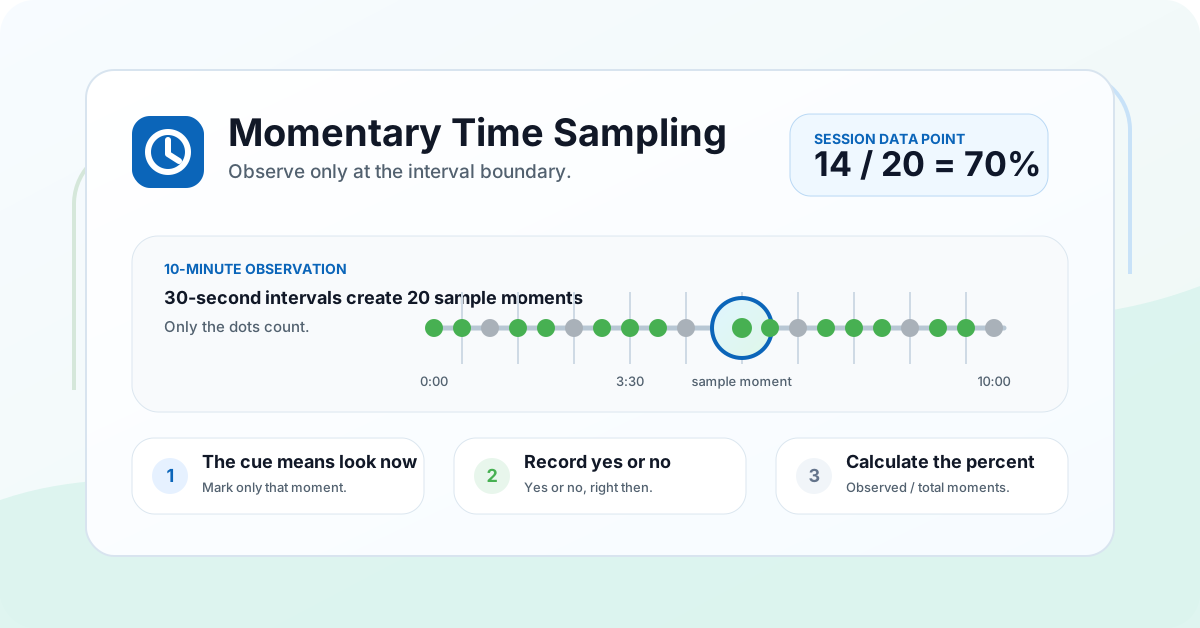
Imagine a 10-minute observation with 30-second intervals. That gives you 20 sample moments. At each cue, you mark whether the target behavior is happening right then - not whether it happened earlier in the interval and not whether it happens during the response window.
If engagement is present at 14 of the 20 sample moments, the session data point is 70%. You did not count every second of engagement. You sampled the observation consistently enough to get a usable percentage.
What is Momentary Time Sampling?
Momentary Time Sampling is a discontinuous observation method. You divide the observation period into equal intervals, and at the end of each interval (the “moment”), you record whether the target behavior is occurring or not. You don’t track the behavior continuously. You sample it.
The output is a percentage: number of moments the behavior was observed, divided by the total number of moments observed. If you observed 20 moments and the behavior was present at 12 of them, the data point is 60%.
This contrasts with the other interval methods:
Partial interval
Mark yes if the behavior occurred at any point during the interval.
Best when brief or variable behaviors need to be noticed. It tends to overestimate duration.
Whole interval
Mark yes only if the behavior occurred for the entire interval.
Best for sustained behaviors you want to increase. It tends to underestimate duration.
Momentary time sampling
Mark yes only if the behavior is occurring at the moment the interval ends.
Best for continuous, high-rate, or distributed behaviors across longer observations. It misses what happens between sample moments.
A brief history note: MTS was developed in the 1970s as a way to make observational research feasible in classrooms and group settings, where continuous frequency or duration recording was impossible for a single observer. Cooper, Heron and Heward describe it as “particularly well suited to behaviors that occur at relatively high frequencies, behaviors of long duration, or when multiple individuals must be observed simultaneously.”
The trade-off is that MTS is a sample. Anything happening between the sampling moments is, by design, not recorded. That’s the point - and it’s the limitation.
When MTS is the right choice
A few scenarios where MTS is the cleanest method:
1. Classroom-wide on-task behavior. A SPED teacher needs to know whether students are on-task during morning circle. Frequency would require tracking dozens of behaviors per minute. Duration would require separate continuous timers. MTS with a 30-second interval gives a clean percentage of on-task moments for each student’s separate tracker.
2. Engagement during a long instruction session. A BCBA is tracking engagement during a 60-minute language session - whether the learner is using the assigned materials, responding through their communication mode, or participating in the current activity as defined in the plan. The behavior is sustained and continuous. Frequency wouldn’t capture it (engagement isn’t a discrete count). Duration would require a continuous timer that the BCBA can’t run while also delivering trials. MTS at 1-minute intervals gives a practical estimate of engaged moments without disrupting the trials. This example uses engagement as the measured behavior so the method is illustrated through participation and access, not through a stigmatizing decrease target.
3. Parallel play in early intervention. A BCBA is tracking whether a 4-year-old is engaged in parallel play during a 30-minute peer interaction. Engagement is continuous and not easily countable. MTS at 1-minute intervals gives a usable measure of engagement proportion.
4. Engagement in a group setting. A school psychologist is observing four students during a group activity. One observer, four separate student sessions, 20 minutes. If the observer can mark each student’s separate tracker at the 1-minute cue inside the entry window, each student gets enough sample moments for a usable engagement estimate. If the observer must rotate one student at a time, extend the observation or adjust the interval so each student still gets at least 15-30 sample moments.
5. Behavior during a long observation window. Any time the observation window is long enough that continuous recording is impractical, and the behavior is the kind where “is it happening right now?” is a meaningful question.
When MTS is the wrong choice
A couple of scenarios where MTS is the wrong method:
1. Low-rate or discrete behaviors. If the target behavior happens 2-3 times per session and each instance is brief, MTS will miss most of the instances by design. The behavior happens between sampling moments and isn’t captured. Use frequency instead.
2. Behaviors where exact count or exact duration matters clinically. If the clinical question is “how many dysregulation episodes today” or “how long was the longest episode,” MTS doesn’t answer either question. It answers “what proportion of sample moments showed an episode in progress.” Use frequency or duration if the count or duration is the clinically meaningful number.
Step-by-step setup
Setting up MTS well takes a few decisions in advance.
1. Define the target behavior operationally.
Before MTS or any recording method, write a clear operational definition. The definition should be specific enough that two observers, watching the same moment, would agree whether the behavior is occurring. “On-task” is too vague. “Engaged with the assigned activity by using materials, responding through the learner’s communication mode, initiating a relevant response, or participating in the current routine as defined in the plan” is more useful and easier to individualize.
2. Pick the interval length.
Interval length depends on behavior rate and observation length. A few rules of thumb:
- High-rate behaviors: shorter intervals (15-30 seconds). The shorter sample makes sure you catch enough variation.
- Lower-rate behaviors: longer intervals (1-5 minutes). Longer samples reduce observer fatigue.
- Long observation windows: longer intervals are more sustainable. A 60-minute observation at 15-second intervals is 240 sample moments, which is exhausting. A 60-minute observation at 1-minute intervals is 60 moments, which is workable.
- Multiple separate sessions: longer intervals can help, but the observer still needs to mark each student’s separate tracker inside the brief entry window. If four student sessions cannot be marked reliably at the cue, reduce the group, rotate observations, or adjust the observation plan while keeping enough sample moments per student.
3. Pick the sampling cue.
MTS requires a reliable cue at the end of each interval. The cue is what tells the observer “this is the sample moment; record what is true now.” Common cues include:
- A vibration or chime from a phone or tablet timer.
- A discreet earpiece beep (for in-classroom observers who don’t want students to hear the cue).
- A visual cue on a screen.
The cue has to be brief so it doesn’t distort the behavior being observed. If your cue is a loud alarm, you’ve changed the environment, and the data is no longer about the natural behavior.
4. Pick the entry window.
After the sampling cue, the observer has a brief entry window to mark whether the behavior was occurring at the exact sample moment. TallyFlex uses a 15-second entry window by default. If multiple student sessions are active, each student’s session and tracker data stay separate; the observer still needs enough time to mark the sample moment reliably for each active session being observed. It is not a 15-second observation period. If observers start recording anything that happens during the window, they have moved away from MTS and toward partial interval recording.
5. Pick the observation window length.
How long is a session? For classroom observations, 15-30 minutes is common. For clinical sessions, the observation might be the full session. The number of sample moments per session should be enough to give you a stable percentage - typically 15-30 sample moments minimum.
6. Run the observation.
The observer follows the timer. At each cue, mark whether the target behavior was occurring at that exact moment. Continue. Don’t try to record what happened between cues - that’s not MTS, that’s continuous recording.
7. Calculate the data point.
At the end of the observation, count the number of sample moments where the behavior was occurring, divide by the total number of sample moments, multiply by 100. That’s your percentage for the session. Plot it on a line graph using the same graphing convention you use for other ABA session data.
Real-world examples
A few examples drawn from how schools and clinics actually use MTS.
Example 1: Classroom-wide on-task behavior.
A SPED teacher in a public school has six students in a self-contained classroom. She wants on-task data during morning circle (20 minutes, 9:00-9:20). She picks a 1-minute interval and runs separate sessions for each student being observed. At each cue, the teacher marks whether each student’s individualized engagement definition was met at that sample moment. After 20 minutes, each student has 20 sample moments. The data is plotted as percent on-task per student per day.
Example 2: Engagement during a 1-hour language session.
A BCBA is tracking engagement during a 1-hour language session with a 6-year-old - whether the learner is using the materials, responding through their communication mode, or initiating a relevant response when the BCBA presents a trial. Engagement is sustained and continuous, so frequency or duration wouldn’t capture it cleanly. She picks a 30-second interval, which gives her 120 sample moments per session. At each cue, she records whether the learner was engaged at that moment. The session yields a percentage she compares across baseline and after engagement-supporting changes (pacing, materials, choice). Tracking engagement as the increase target keeps the example focused on participation and access rather than making a reduction target the default.
Example 3: Group engagement observation.
A school psychologist is observing four students during a 30-minute group activity. She picks a 1-minute interval and keeps each student’s tracker separate. At each cue, she marks whether each student’s engagement criteria were met at that sample moment. The 30-minute observation gives 30 sample moments per student. Engagement percentages for each student go in the report.
How TallyFlex handles MTS
TallyFlex’s MTS workflow is built around the sample moment, not around manual interval tracking. The implementation:
- Full-screen overlay during sample moments. The overlay covers the rest of the app so the observer focuses on the decision: occurring or not occurring.
- 15-second entry window for recording what was true at the exact sample moment.
- Configurable interval lengths from 15 seconds to 10 minutes.
- Separate tracker data during simultaneous sessions so an observer can run separate student sessions at the same time without combining students into one tracker.
- Automatic percentage calculation at the end of the observation.
- Reports that plot the data alongside other recording methods on the same graph.
For the full feature list and the documentation walkthrough, see /docs/sessions/recording-methods. For the broader question of when to pick MTS vs partial interval vs frequency, see Partial vs Whole Interval Recording: A Quick Guide and How to Choose the Right ABA Recording Method. The interactive tool at /recording-method-finder walks through the decision in three questions.
For school teams collecting sampled observation on school-issued devices, see Chromebook ABA Data Collection and Offline ABA Data Collection.
Common MTS mistakes
A few things to watch for:
- Treating the cue as a “during the interval” check. The whole point of MTS is the moment, not the interval. If your observers are recording “any time during the interval,” they’re doing partial interval, not MTS.
- Interval too short for observer capacity. If the observer can’t reliably mark the data at every cue, the interval is too short. Lengthen it.
- Cue too disruptive. Any cue that changes the environment changes the data. Use vibration or a discreet sound.
- Too few sample moments. A 5-minute observation at 1-minute intervals gives 5 sample moments, which produces unstable percentages. Aim for 15-30 sample moments minimum.
- Mixing methods within a session. Decide whether you’re doing MTS, partial interval, or whole interval, and stick with one. Mixing them produces uninterpretable data.
Closing
Momentary Time Sampling is the right method for high-rate, continuous, or distributed behaviors that frequency or duration recording can’t capture. It’s especially valuable in classroom and group settings when each student has a separate tracker and the observer can mark the sample moment reliably. The set-up takes a few decisions - operational definition, interval length, sampling cue, entry window - and the data stays interpretable as long as you stick to “the moment” and not “during the interval.”
If you’re running paper grids and a kitchen timer for MTS today, that’s the workflow worth replacing first. Start Tracking on TallyFlex and run your first MTS session with the full-screen overlay. The percentage builds itself.