· David Cruz · ABA Best Practices · 7 min read
Duration and Latency Recording - When to Use Each in ABA
Duration and latency both involve timers. They answer different clinical questions. Here's a decision framework with examples, plus how to collect time-based data without juggling stopwatches.

Key Takeaways
Duration and latency recording both use timers, but they answer different questions. Use duration recording when how long a behavior lasts matters - dysregulation episodes (operationally bundled), engagement during instruction, sustained attention. Use latency recording when the time between a cue and the response matters - following instructions, transitions, starting work. Both require behaviors with clear start and end points. The question to ask: “Do I need to know how long this lasted, or how quickly they responded?”
Timer data falls apart when the person collecting it has to juggle a stopwatch beside the session. TallyFlex includes Duration and Latency recording with tap-to-start timers, reminders when a duration tracker is still running, and max-latency behavior when a timeout is configured.
This guide helps you choose the timer method. For the broader method decision, use the Recording Method Finder.
Duration vs Latency: The Quick Decision
| Question | Recording Method | Example |
|---|---|---|
| ”How long did this last?” | Duration | Dysregulation episode lasting 8 minutes |
| ”How quickly did they respond?” | Latency | Begins following instruction within 3 seconds |
If you can’t identify exactly when a behavior begins and ends, interval recording may be a better fit. For a complete overview of all methods, see our recording method guide.
Duration Recording
Duration recording measures how long a behavior lasts from start to finish.
Start timing when the behavior begins. Stop when it ends. Your data point is a time measurement - seconds, minutes, or hours.
When to Use Duration Recording
Duration makes sense when how long something lasts is what actually matters:
- Dysregulation episodes (operationally bundled): A parent reports episodes are “constant.” With an operational definition - for example, any episode in which the learner engages in 2+ of crying loudly, screaming, throwing objects, hitting/kicking, or dropping to floor simultaneously for >=3 continuous seconds, ending when none of those behaviors are observed for 30 consecutive seconds (per Master ABA’s operational-definitions library; see
mastery-criteria-aba-guide.mdxfor the canonical TallyFlex example) - duration data reveals whether episodes last 2 minutes or 20 minutes. Track duration to see whether episode length changes after antecedent strategies and FCT teaching are introduced. - On-task behavior: How long does a student sustain attention during independent work? 30 seconds or 10 minutes?
- Time in designated area: Tracking how long a student stays in their seat or at their workstation.
- Dysregulation episodes once they begin: How long does an episode last once it starts? 3 minutes or 30 minutes makes a big difference in planning support.
- IEP goals: Many IEP objectives specify duration targets - “Student will remain engaged in group instruction for 10 minutes.”
Key insight: A student who has 3 dysregulation episodes on Monday and 3 on Tuesday shows identical frequency. But if Monday’s episodes lasted 2 minutes each and Tuesday’s lasted 15 minutes each, you’re dealing with a very different situation. Duration captures what frequency misses.
The challenge with both methods is managing a timer while running a session. TallyFlex handles both duration and latency recording with built-in timers that start and stop with a single tap. The app timestamps everything and notifies you if a timer is still running, so you stay focused on your student instead of juggling a stopwatch.
Collecting Accurate Duration Data
Two requirements:
- A clear start - You can identify exactly when the behavior begins
- A clear end - You can identify exactly when the behavior stops
Be specific about the end point. “Episode ends when the student stops crying” is vague. “Episode ends after 30 consecutive seconds without crying, screaming, throwing, hitting/kicking, or dropping to floor” gives every team member the same rule (per the operationally-bundled definition above).
You can track total duration (sum of all episodes) or per-occurrence duration (length of each episode). Per-occurrence data is richer - you can see if episodes are getting shorter even when frequency stays the same.
Latency Recording
Latency recording measures the time between a cue and the response.
The cue can be a verbal instruction (“sit down”), a signal (the bell ringing), or any event the student should respond to. Start timing when the cue happens. Stop timing when the student begins responding.
When to Use Latency Recording
Latency matters when how quickly someone responds is what you need to measure - even if accuracy is already high:
- Following instructions: A student follows directions correctly but takes 30-45 seconds to start. Accuracy data shows 100%. Latency reveals the delay.
- Transitions: How quickly does a student start packing up after the bell? Critical for classroom scheduling.
- Starting independent work: The teacher says “open your journals” - does the student begin in 5 seconds or 45 seconds?
- Response to name: Does a child respond within 5 seconds or 20 seconds when their name is called?
- Safety skills: Skills like stopping at curbs or responding to “Come here” need to happen quickly, not just accurately.
Key insight: A student identifying 10/10 colors with 100% accuracy might not have mastered the skill if each response takes 15-20 seconds with visible problem-solving. Quick, automatic responses suggest true fluency - and the only way to see that difference is by measuring latency.
Collecting Accurate Latency Data
Three requirements:
- A clear instruction - You know exactly when you gave the direction
- A defined response - You know what “starting to comply” looks like
- A visible start - You can tell when the student begins responding
Be specific about both ends. For example: “Start timing after saying ‘sit down’ and stop when the student’s body touches the chair.” When every team member follows the same rule, the data is reliable.
Most programs need a latency criterion - a maximum acceptable response time (for example, “must begin within 5 seconds”). Without it, you can’t determine whether the delay is acceptable or needs intervention.
The Juggling Problem
Here’s the reality: accurate time-based recording requires your attention on a timer while you’re also managing a session, delivering instruction, and maintaining rapport with your student.
Traditional approaches - stopwatches, phone timers, clipboards - create cognitive load that compromises either data accuracy or session quality. Miss the start by a few seconds while prompting, and your data is off. Forget to stop the timer while managing behavior, and you’re guessing.
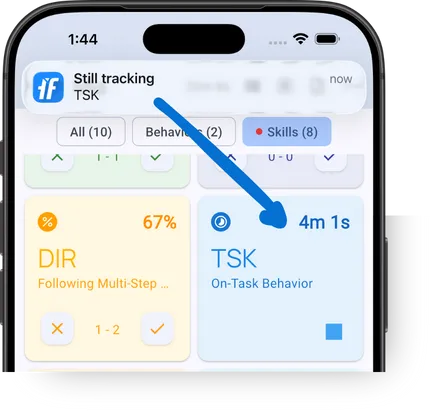
This is exactly why TallyFlex exists. Instead of juggling a stopwatch, you tap a tracker to start timing and tap again to stop. The app timestamps everything, notifies you if a timer is still running, and calculates totals automatically. It works offline on Chromebooks, tablets, and phones - so the environment never gets in the way of good data.
See our recording methods documentation for step-by-step setup instructions.
Common Mistakes to Avoid
Using Duration When Frequency Matters (or Vice Versa)
Mistake: Tracking dysregulation episode duration when the real concern is how many times episodes disrupt class.
Solution: Ask what you actually need to know. If the concern is how long episodes last, use duration. If the concern is how often they happen, use frequency.
Inconsistent Timing Across Team
Mistake: One staff member starts timing at the beginning of the instruction, another at the end. Same behavior, different data.
Solution: Make sure everyone on the team agrees on exactly when to start and stop the timer. Written definitions help - “start timing on the last word of the instruction, stop timing when the student’s hand touches the material.” When everyone follows the same rule, the data is consistent no matter who collects it.
Using Latency Without a Clear Antecedent
Mistake: Trying to measure “latency to engage in repetitive behavior” when there’s no specific trigger.
Solution: Latency requires a clear cue or instruction that the student should respond to. If a behavior happens on its own without a trigger, latency isn’t the right measure - consider frequency or duration instead.
What’s Next?
- Watch the tutorial: Duration & Latency Recording in TallyFlex - 4-minute walkthrough
- Compare all recording methods: How to Choose the Right ABA Recording Method
- Learn about interval recording: Partial vs. Whole Interval Recording Guide
- See recording methods in action: Recording Methods Documentation
- Keep collecting without Wi-Fi: Offline ABA Data Collection
- Start collecting time-based data: See how effortless timing data can be