· David Cruz · ABA Best Practices · 15 min read
Task Analysis Data Collection - A Complete Guide for ABA Practitioners
Learn task analysis data collection for ABA - chaining, prompts, mastery criteria, and heat maps. Simplify your workflow with digital data collection.

Task analysis is an ABA teaching method that breaks complex skills into sequential, teachable steps with prompt level tracking for each step. It answers the question: which specific parts of a skill does my client need help with? Task analysis combined with a good data collection workflow transforms skill acquisition programs from guesswork into measurable progress.
Teaching a child to brush their teeth seems simple until you try to explain every micro-step involved. Pick up the toothbrush. Apply toothpaste. Position the brush. Move in small circles. Rinse. Replace the brush. Each step requires motor planning, sequencing, and often prompting before independence emerges.
Task analysis makes those sequences teachable. But the method only works if your data collection is precise enough to show which steps are improving, which are stuck, and whether your teaching approach is working.
This guide covers task analysis data collection from start to finish - how to structure your analysis, choose chaining methods, record prompt levels, and interpret the patterns your data reveals.
Recording prompt levels for every step during a live session is where paper falls short. TallyFlex was built for exactly this - one-tap prompt scoring per step with auto-advance, heat map visualization, and mastery tracking that updates automatically across sessions.
What Is Task Analysis?
Task analysis is a method of breaking down complex skills into smaller, sequential steps that can be taught individually. Each step represents one discrete action that, when combined with all other steps, completes the entire skill.
As described in Cooper, Heron & Heward’s Applied Behavior Analysis, task analysis serves two purposes: it provides a teaching sequence and a measurement system. You teach each step systematically and record performance on each step to track progress toward independence.
A Simple Example
Skill: Washing hands
| Step | Action |
|---|---|
| 1 | Turn on water |
| 2 | Wet hands under water |
| 3 | Apply soap to hands |
| 4 | Rub hands together for 20 seconds |
| 5 | Rinse hands under water |
| 6 | Turn off water |
| 7 | Dry hands with towel |
Each step is observable, measurable, and has a clear beginning and end. A client either completes the step independently or requires some level of prompting.
When Task Analysis Works Best
Task analysis is particularly effective for:
- Self-care skills - Dressing, toileting, hygiene routines
- Daily living skills - Cooking, cleaning, laundry
- Vocational skills - Job tasks with consistent sequences
- Academic chains - Multi-step math procedures, writing processes
- Play and leisure skills - Games with sequential rules, craft projects
Any skill with a predictable sequence of steps can be taught through task analysis.
Types of Task Analysis Teaching Methods
Once you’ve broken a skill into steps, you need to decide how to teach it. The three main chaining methods each approach the teaching sequence differently.
Forward Chaining
In forward chaining, you teach the first step to mastery before adding the second step. The client completes mastered steps independently while you prompt remaining steps.
How it works:
- Teach Step 1 until the client performs it independently
- Add Step 2, teaching it while the client does Step 1 independently
- Continue adding steps in sequence until the entire chain is mastered
Best for:
- Skills where early steps are naturally reinforcing
- Learners who need early success to stay motivated
- Skills where later steps are more complex and benefit from prior momentum
Example: Teaching shoe-tying using forward chaining means the client masters crossing the laces first, then adding the loop, and so on.
Backward Chaining
In backward chaining, you complete all steps except the last one, which the client performs. Once mastered, you have them do the last two steps, then the last three, and so on.
How it works:
- Complete Steps 1 through N-1, then have the client do Step N
- Once Step N is mastered, complete Steps 1 through N-2, have client do N-1 and N
- Continue backward until the client completes the entire chain
Best for:
- Skills where the final step produces the reinforcement (completed task)
- Learners who struggle with delayed gratification
- Skills where contact with the finished product motivates continued effort
Example: Teaching hand washing using backward chaining means you do everything except drying hands, so the client experiences the completion of the task immediately.
Total Task Presentation
In total task presentation (also called whole task teaching), the client attempts every step in the chain during each teaching opportunity. You provide prompts as needed throughout the entire sequence.
How it works:
- The client attempts all steps each session
- You prompt any steps the client cannot complete independently
- Prompt levels fade for each step as competence develops
Best for:
- Skills the client can already partially perform
- Shorter task analyses with fewer steps
- Skills where practicing the whole sequence builds fluency
- Learners who find partial chains frustrating
Example: Teaching tooth brushing using total task means the client practices the entire routine each time, with prompting provided as needed for any step.
Choosing Your Method
| Factor | Forward | Backward | Total Task |
|---|---|---|---|
| Learner needs early success | Good | Best | Moderate |
| Skill has natural endpoint reinforcement | Moderate | Best | Good |
| Skill is partially acquired | Poor | Poor | Best |
| Chain is long (10+ steps) | Good | Good | Challenging |
| Chain is short (under 6 steps) | Any work | Any work | Best |
Many practitioners default to total task presentation because it most closely resembles natural teaching. But for clients who struggle with complex sequences or need clearer success markers, forward or backward chaining may produce faster acquisition.
Recording Prompt Levels
The core of task analysis data collection is recording the prompt level required for each step. This tells you not just whether a step was completed, but how much support was needed.
Standard Prompt Hierarchy
Most task analysis data collection uses prompt levels from most to least intrusive. TallyFlex also records Independent and No Response as scoring outcomes, not as prompts:
| Code | Prompt Level or Outcome | Description |
|---|---|---|
| FP | Full Physical | Hand-over-hand guidance through the entire movement |
| PP | Partial Physical | Light touch or guidance to initiate or complete movement |
| M | Model | Demonstrating the action for the client to imitate |
| V | Verbal | Spoken instruction or reminder |
| G | Gestural | Pointing, nodding, or other non-verbal cue |
| I | Independent outcome | Completed without any prompt |
| NR | No Response outcome | Learner did not attempt or complete step |
Your program may use variations - some add visual prompts, some split verbal into direct and indirect, some use numerical codes. What matters is consistency across your team.
Recording Methods
Single-Opportunity Assessment
In single-opportunity recording, you test each step in sequence. When the client fails to perform a step independently, you stop the assessment for that trial. This method measures independent performance only.
Best for:
- Baseline assessment before teaching begins
- Periodic probes to assess generalization
- Situations where prompting during assessment would contaminate the data
Multiple-Opportunity Assessment
In multiple-opportunity recording, you assess each step regardless of performance on previous steps. If a client cannot complete a step, you complete it for them (or prompt it), then move to the next step to assess their independent performance.
Best for:
- Ongoing progress monitoring during teaching
- Identifying specific steps that need more instruction
- Understanding patterns across the entire chain
What Your Data Sheet Should Capture
For each session, your task analysis data collection should record:
- Date and session number - For tracking progress over time
- Therapist/instructor - To monitor inter-rater patterns
- Teaching method used - Forward, backward, or total task
- Prompt level for each step - The code indicating support provided
- Notes - Anything unusual about the session or environment
A well-designed data sheet makes recording fast during session and analysis easy afterward.
Analyzing Task Analysis Data
Raw prompt codes become meaningful when you analyze patterns across steps and sessions. Here’s what to look for.
Step-by-Step Patterns
When you examine data horizontally (across steps within a session), you identify:
- Consistent barriers - Steps that require high prompts session after session
- Fluency breaks - Steps where independence drops despite competence before and after
- Natural groupings - Clusters of steps that seem to improve together
A step that stays at full physical prompt while surrounding steps reach independence signals a problem. The step might need to be broken down further, the prompt fading might need adjustment, or there may be a motor or comprehension issue specific to that action.
Session-by-Session Trends
When you examine data vertically (same step across multiple sessions), you track:
- Acquisition rate - How quickly prompt levels decrease for each step
- Maintenance - Whether independence sustains across sessions
- Regression patterns - Steps that lose independence (may indicate insufficient mastery criteria)
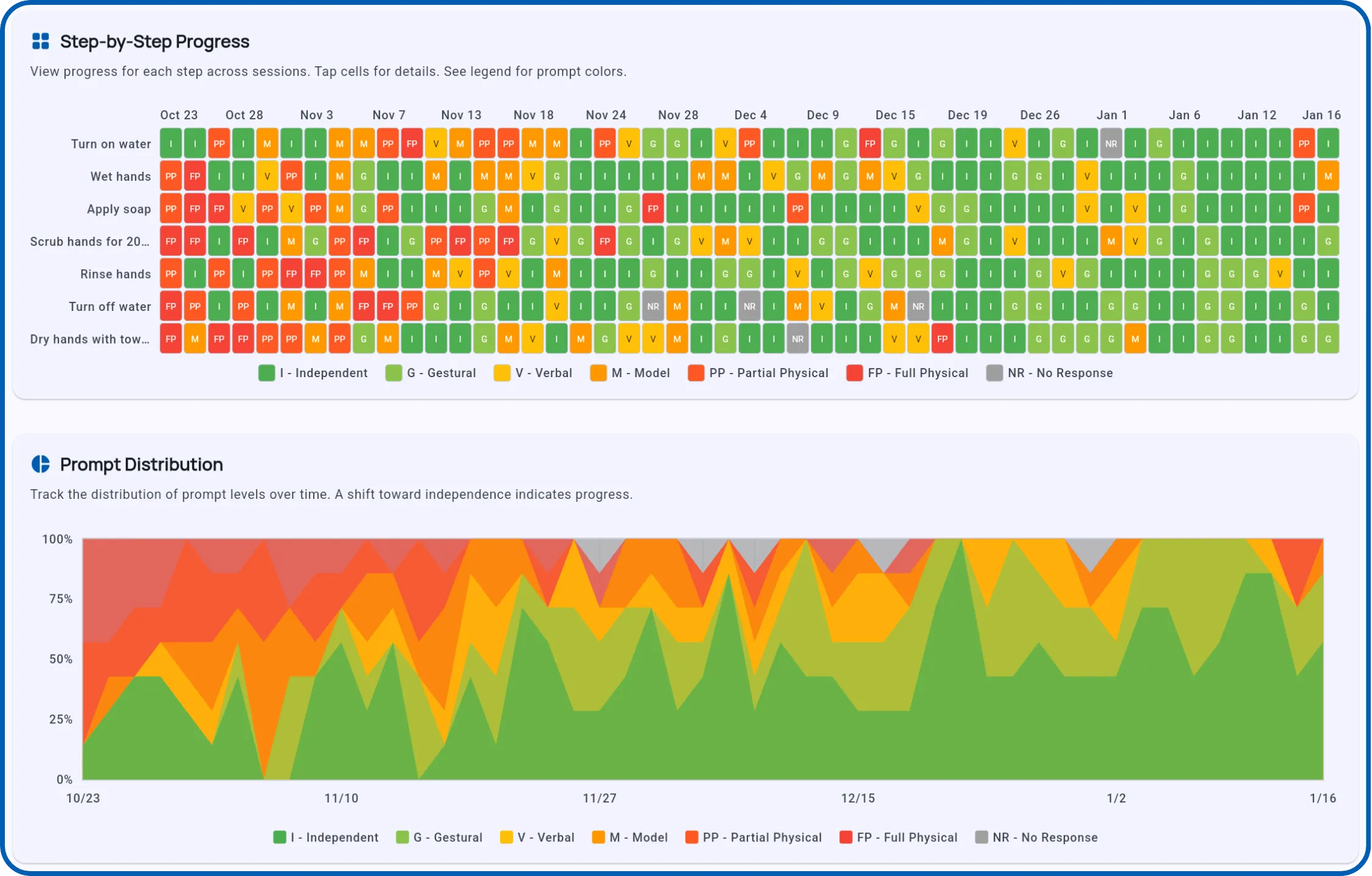
Graphing prompt levels over time for each step creates a visual representation of acquisition. Many practitioners use heat maps where colors represent prompt levels - green for independent, yellow for gestural, orange for model, red for physical. Patterns become visible at a glance.
Common Patterns and What They Mean
Plateau with high prompts: If several steps remain at partial or full physical prompt across 5+ sessions, consider whether the task breakdown is appropriate. Steps might need to be subdivided further.
Inconsistent performance: If a step alternates between independent and prompted across sessions, the skill may not be truly acquired. Increase mastery criteria before moving on.
Regression after mastery: If previously independent steps start requiring prompts again, check for environmental changes, skill interference from new learning, or insufficient practice to maintenance.
Clustered acquisition: If steps 3-5 all improve together while 6-8 remain stuck, there may be a transition point in the skill that requires different teaching. Look for what changes between step 5 and step 6.
Setting Mastery Criteria
Before teaching begins, define what mastery means for this task analysis. Clear criteria prevent premature advancement and provide objective endpoints.
Common Mastery Criteria Approaches
Percentage Independent
The client completes a specified percentage of steps independently across consecutive sessions.
Example: “80% of steps performed at independent level across 3 consecutive sessions”
This approach works well for longer task analyses where perfection on every step may be unrealistic initially.
All Steps Independent
The client completes every step at the independent level across consecutive sessions.
Example: “100% independent across 3 consecutive sessions”
This is the most rigorous standard and appropriate when every step is safety-critical or when the skill must be performed fluently.
Maximum Prompt Level
The client requires no more than a specified prompt level on any step.
Example: “No step requiring more than gestural prompt across 3 consecutive sessions”
This approach allows some prompting while ensuring the client doesn’t need intensive support.
Maximum Prompt Count
The client stays under a set number of prompts at a specific level.
Example: “No more than 2 verbal prompts per session for 3 consecutive sessions”
This approach supports prompt fading goals while allowing limited assistance.
Factors in Choosing Criteria
- Safety requirements - Skills involving sharp objects, heat, or other hazards may require 100% independence
- Functional independence - Can the client use this skill practically at the mastery level you’ve chosen?
- Maintenance considerations - Stricter criteria often produce better maintenance
- Learner history - Learners prone to regression may need higher mastery criteria
Document your mastery criteria before teaching begins. This prevents goalpost-moving and ensures the team shares the same endpoint.
When to Use Task Analysis vs. Other Methods
Task analysis isn’t the right approach for every skill. Here’s how it compares to other ABA recording methods.
Task Analysis vs. Discrete Trial Training
Use task analysis when:
- The skill is a chain of sequential steps
- Each step depends on the previous step
- The skill is performed as a continuous routine
Use discrete trial training when:
- You’re teaching isolated responses (labeling, matching)
- Responses don’t form a natural sequence
- You need massed practice of single targets
Task Analysis vs. Frequency Recording
Use task analysis when:
- You need to know which specific components of a skill require support
- The skill has multiple steps that may acquire at different rates
- Teaching involves systematic prompting and fading
Use frequency recording when:
- You’re counting occurrences of a single defined behavior
- The behavior is already in the client’s repertoire
- You’re tracking rate of responding rather than skill acquisition
Task Analysis vs. ABC Data
Use task analysis when:
- You’re teaching new skills through systematic instruction
- The target is skill acquisition, not behavior reduction
- You know what you’re teaching and need to track learning
Use ABC data when:
- You’re trying to understand why a behavior occurs
- You need to identify antecedents and consequences maintaining behavior
- The focus is assessment rather than instruction
For more on choosing recording methods, see our guide to ABA recording methods.
Practical Tips for Better Data Collection
Write Steps at the Right Grain Size
Steps that are too broad hide where learning breaks down. Steps that are too fine create data overload. The right grain size depends on the client.
A neurotypical adult might wash hands in 7 steps. A client with significant motor planning challenges might need those same actions broken into 20 steps. Match the task analysis to the client, not the other way around.
If a client gets stuck, break that step down further. You can always consolidate steps later as fluency develops.
Use Consistent Prompt Definitions
Everyone on the team must agree on what each prompt level means. “Partial physical” to one therapist might be “gestural” to another if definitions aren’t explicit.
Create operational definitions for each prompt level specific to this task. What does a gestural prompt look like for step 3? What counts as verbal for step 7?
Record During Session, Not After
Like all behavior data, task analysis recording is most accurate when done in the moment. Reconstructing from memory introduces errors.
Use a data sheet or app that allows quick marking during the task. A simple grid with steps as rows and sessions as columns lets you check off prompt levels in seconds.
Analyze Weekly, Not Monthly
Waiting weeks to review task analysis data means waiting weeks to catch problems. Review data at least weekly to identify:
- Steps that aren’t progressing
- Steps ready for prompt fading
- Patterns suggesting teaching method changes
Timely analysis enables timely adjustments.
Task Analysis Data Collection in TallyFlex
Paper data sheets work until you’re trying to score 12 steps across multiple sessions while a client waits. Built with BCBA input, TallyFlex’s task analysis recording method was designed for ABA workflows. Collect data during sessions, understand progress at a glance, and document outcomes without extra work.
Configurable Prompt Hierarchies
Set up your prompt hierarchy once per program. The default seven levels (I, G, V, M, PP, FP, NR) work for most programs, but you can customize for specialized protocols. Add, remove, or reorder prompt levels to match your clinical approach.
Each level has an assigned weight for automatic mastery calculations. Independent always has weight 0 - the system uses this to calculate percent independent across sessions without manual math.
Step-by-Step Scoring During Sessions
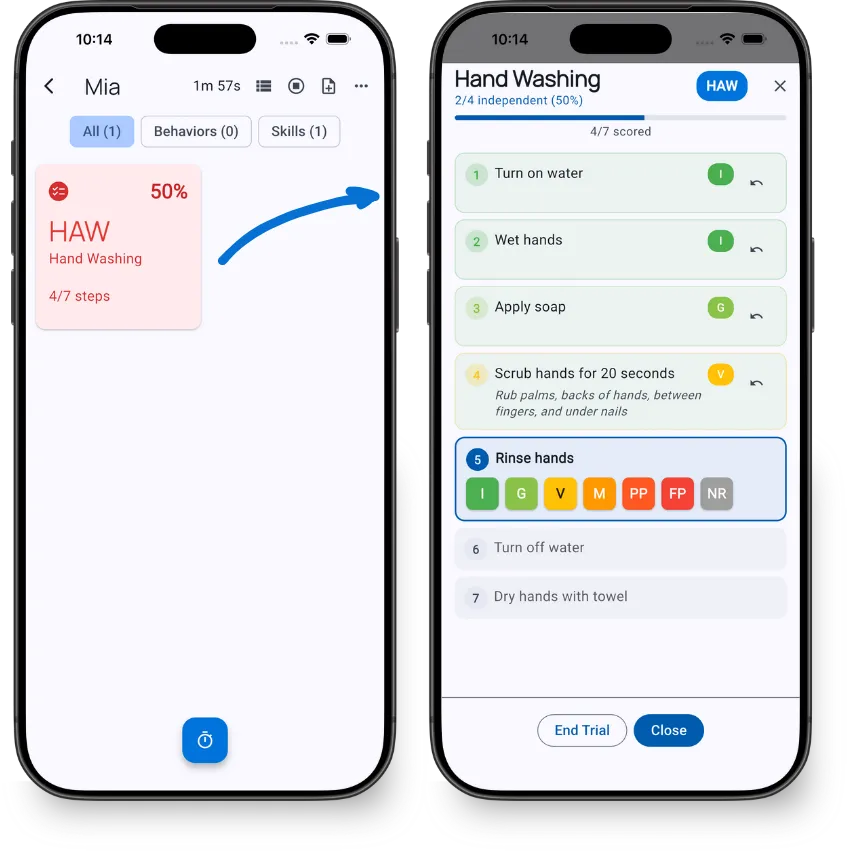
During live sessions, TallyFlex displays each step in sequence and highlights the current active step. Tap a prompt level to score it and auto-advance to the next unscored step. The interface shows:
- Completed steps in green with prompt badges
- Current step highlighted in blue with prompt buttons visible
- Future steps in grey, waiting to be scored
For backward chaining, tap any step to score out of order. For single-opportunity assessment, the session stops automatically after the first non-independent response.
Chaining and Assessment Modes
Configure each task analysis program with:
- Chaining mode: Forward, backward, or total task
- Assessment mode: Single-opportunity (stops at first error) or multiple-opportunity (score all steps)
Chaining is instructional guidance for the therapist. The app highlights the active step and auto-advances after scoring to keep the flow moving, while still letting you tap any step when you need to score out of order. Single-opportunity mode stops the trial after the first non-independent response.
Heat Map Visualization
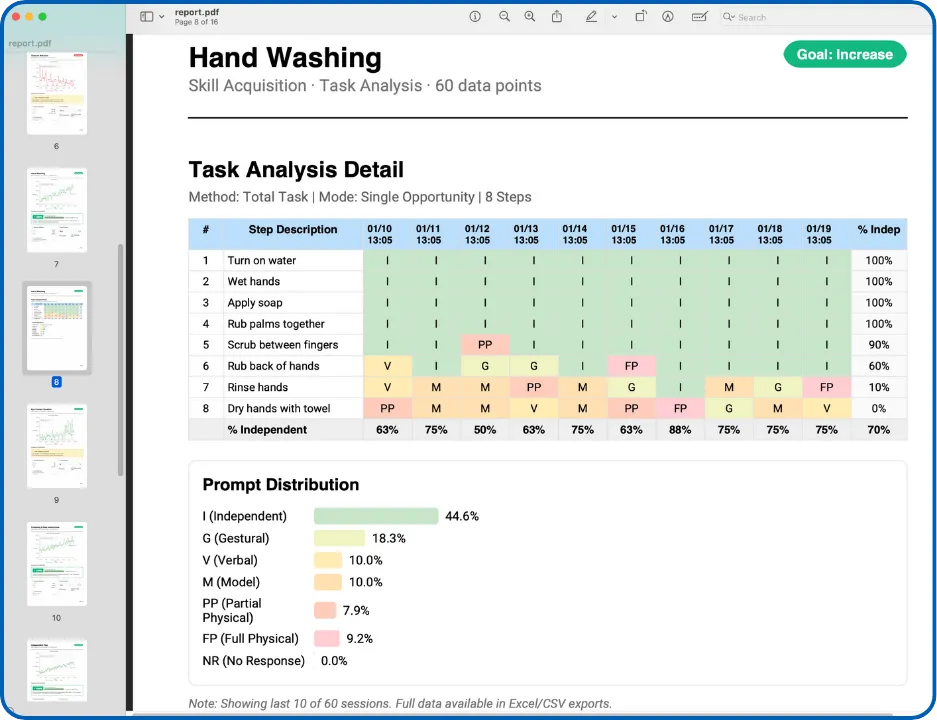
The task analysis heat map shows prompt levels as colors across steps and sessions. At a glance, you can see:
- Which steps consistently require prompts (red/orange clusters)
- Which steps have reached independence (green columns)
- Patterns across time of day when multiple sessions occur per day
Tap any cell to see session details. When multiple sessions occur per day, the heat map displays them separately so you can identify time-of-day patterns in performance.
Mastery Criteria Built for Task Analysis
Set mastery criteria that match your clinical goals:
- Percent independent: “80% of steps independent across 3 consecutive sessions”
- All steps independent: “100% independent across 3 sessions”
- Maximum prompt level: “No step requiring more than gestural prompt”
- Maximum prompt count: “No more than 2 verbal prompts per session”
The mastery progress display shows how close each program is to meeting criteria, with session-by-session indicators showing which sessions passed or failed.
Exports for Supervision and Reporting
Export task analysis data to CSV, Excel, or PDF with full prompt-level detail. The Excel export displays steps as rows and sessions as columns - the same format BCBAs expect from traditional paper data sheets.
Each cell shows the prompt abbreviation, with summary rows for percent independent and independent/total counts. Share with supervisors or include in progress reports without manual data entry.
Getting Started
- Create a new tracker and select “Task Analysis” as the recording method
- Add your steps in sequence
- Choose chaining mode (forward, backward, or total task)
- Choose assessment mode (single or multiple opportunity)
- Set mastery criteria
- Start a session and begin scoring
See how TallyFlex simplifies task analysis data collection so you can focus on teaching, not paperwork. Explore all recording methods TallyFlex supports.
Key Concepts Summary
Task analysis breaks complex skills into teachable steps with clear sequence.
Chaining methods determine teaching order: forward (first step first), backward (last step first), or total task (all steps each session).
Prompt hierarchy provides consistent codes for recording support level on each step.
Assessment modes include single-opportunity (stop at first failure) and multiple-opportunity (assess all steps regardless of errors).
Mastery criteria define clear endpoints before teaching begins - percentage independent, all independent, or maximum prompt level.
Maximum prompt count caps how often a specific prompt level can be used during a session.
Data analysis examines patterns across steps and sessions to guide clinical decisions.
Key Takeaways
Task analysis breaks complex skills into teachable steps, and precise data collection reveals where support is needed. By recording prompt levels for each step across sessions, you can see patterns - which steps are mastered, which need more practice, and whether your teaching method is working. The three main chaining approaches (forward, backward, total task) each suit different skills and clients. Mastery criteria should be clear before teaching begins: percentage independent, all steps independent, maximum prompt level, or maximum prompt count. When you analyze task analysis data effectively, you make better clinical decisions about fading prompts, adjusting instruction, or revising the task breakdown.
What’s Next?
- Compare recording methods: How to Choose the Right ABA Recording Method covers when to use task analysis vs. frequency, duration, and interval recording
- Learn about ABC data: Complete Guide to ABC Data Collection explains when function assessment is more appropriate than skill teaching
- See the feature in the app: Task Analysis recording guide explains setup, scoring, and reports
- Understand report calculations: Understanding Report Statistics explains how averages and trends are calculated
- Start collecting task analysis data: See how TallyFlex handles task analysis - configurable prompt hierarchies, step-by-step scoring, heat map visualization, and Excel exports with steps as rows and sessions as columns
Good task analysis data collection shows you exactly where learning is happening and where it’s stuck. That clarity drives better teaching decisions.